Why is Agile Way of Working Relevant now?
Traditional work approaches were not designed for today’s demands
The rapid and significant changes in the world put special demands on how we work:
Volatility, uncertainty, and ambiguity demand higher adaptability and resilience.
Digital transformations need strategic agility, innovation, and a growth mindset.
Remote and distributed working require renewed collaborations and remote leadership.
Traditional work approaches were not designed for these realities. We need new work capabilities and skills. Agile, Lean, and Digital Ways of Working instill a value and change mindset, unlock flexibility and collaboration, and engage the people intrinsically.
holistic and people-first
Agile Ways of Working (WoW) achieve better outcomes for stakeholders and better work experiences for people. To accomplish that, we need a holistic, mindset-based, and organization-wide approach.
Our workshops, e-courses, and coaching help teams and organizations build competencies and practices for all the pillars of Agile WoW: strategy & goal-setting, mindset & culture, frameworks & practices, structure & collaboration, leadership, people enablement, and change management.

The next era of business thrives on learning

Top trends:
1. Lead through a culture that reinforces learning
2. Upskill for workforce agility
3. Rethink delivery to get the most out of learning
Experience-Based Macro and Microlearning
Learning at agileXL is based on real-world experience. The facilitator of the course is always a practitioner and coach. With that formula, we can go beyond knowledge and skills alone. We help you build competencies including “power” behaviors so that you can ‘be’ Agile, not just ‘do’ Agile.
To maximize learning efficiency and retention, we use a blended approach with macro and microlearning. Multiple formats also enable learning in the flow of work so that you don’t always have to block entire days

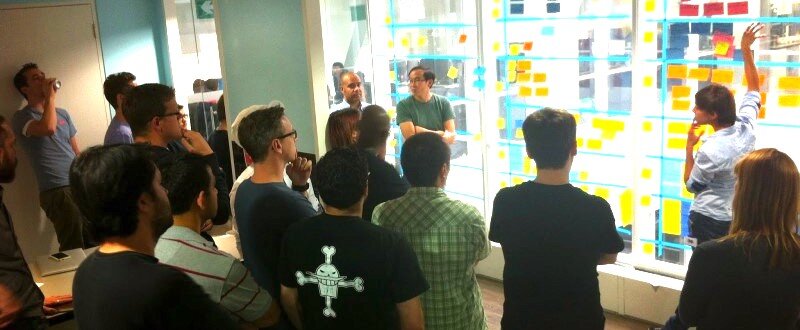

Agile Ways of Working Signature Course
Agile Ways of Working is our signature course in which you build the key skills and practices to think Agile and work Agile for the digital world.
On the agenda, you find Agile culture, (remote/distributed) collaboration, definition and planning methods, structures, leadership, people engagement, change resilience, and more.
This course is available as a team workshop, e-learning course, or 5-week mastery program.



Trusted By Leading Organizations
























Featured Resources


agileXL People

Hey, I’m Bruce Schoor, Agile Way of Working Coach and agileXL founder.
My differentiation is the ability to make teams and organizations work better holistically. Not just by implementing a framework like Scrum or SAFe. By understanding the objectives, and addressing all relevant dimensions that unleash value, flow, agility, and people potential. For both software and non-software environments.
For this, I conduct assessments, build skills, and coach changes specifically for what teams and people need. My competencies come from my track record at Microsoft, from coaching teams worldwide, and from scientific insights. For large engagements, I partner with like-minded coaches.
I am Dutch-Canadian with an MSc degree, lived on 3 continents, speak 5 languages, and work worldwide. My core values include reliability, respect, openness, and pragmatism. For more details, please view my Linkedin profile.
Explore the benefits of Agile Ways of Working for your case
An exploratory advice session, no-cost or obligation
Are you considering Agile Ways of Working?
If yes, this 30-minute advice session is useful for you.
We look at your specific objectives and current state, and show you what value outcomes Agile Way of Working could generate. Plus we demo a useful change.
Session agenda:
Goal-setting: what are your objectives and WoW challenges?
Strategy: what changes and skills should you prioritize?
Demo: an example of a valuable Agile WoW change for your case
Q&A
L&D partner for Organization-Wide Agile Learning

Skill assessment, learning program design, academy set-up
As a partner with corporate L&D departments, we assist in setting up organization-wide Agile learning for the workforce. Specific services include skill gap assessment, learning design, and internal academy creation.
Transition To An Agile Way Of Working
We help organizations with Assessment, strategy, and coaching for a pragmatic and people-centered introduction to agile
Shaping an Agile organization demands a holistic, tailored, and pragmatic approach. We help you with changes and skills that map to your objectives and constraints.
To support this, we use a transition framework that includes Agile assessment, Agile organization design, and change management & coaching. We help you create an Agile backbone with capabilities and skills tailored to your objectives.
AGILEXL TRANSITION FRAMEWORK
(Click to enlarge)
agileXL Blog Posts


Testimonials


On Sale This Week
Featured
